
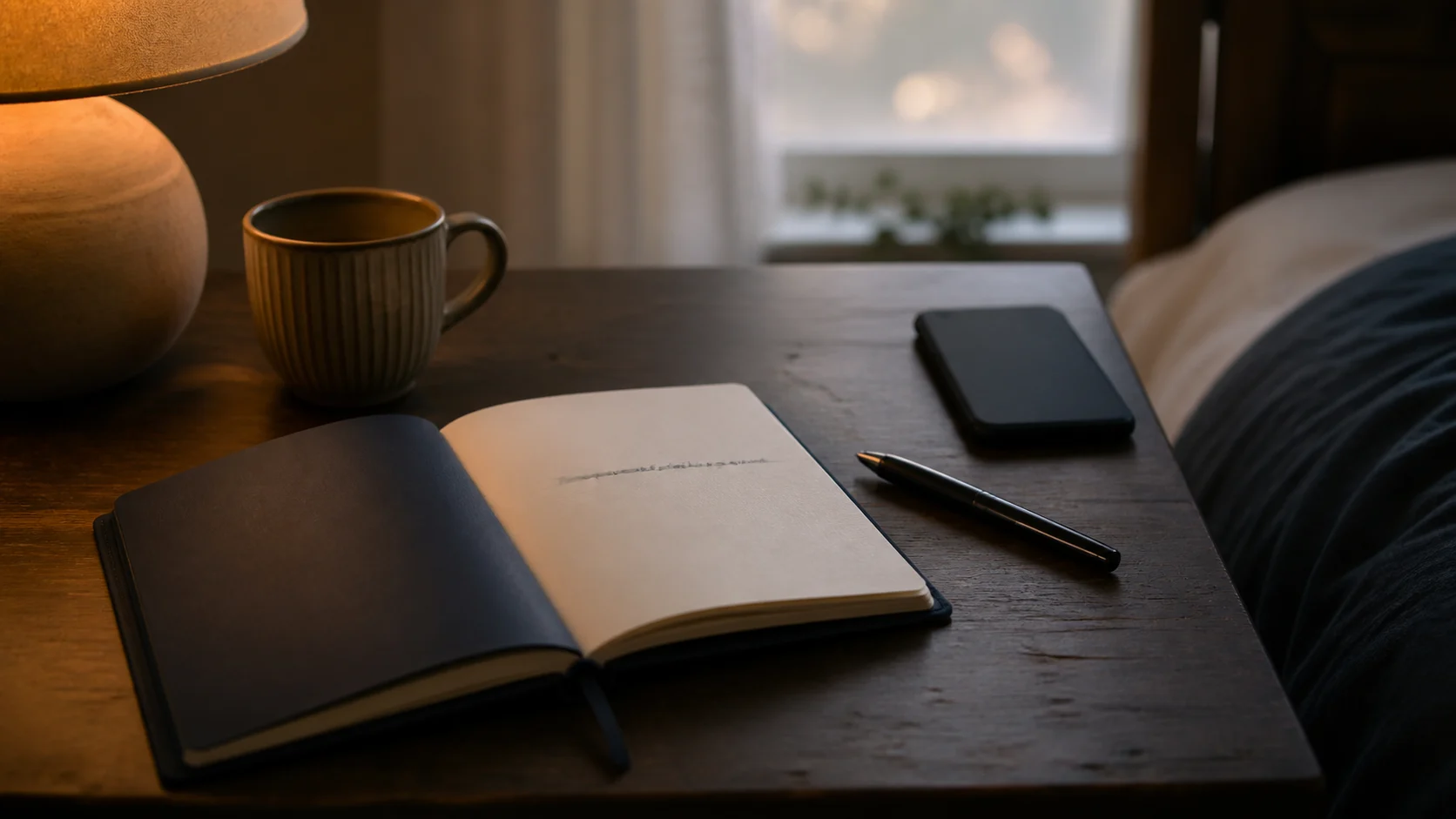
A one line a day journal is exactly what it sounds like: a place to leave one small record of each day. It can hold a detail, a feeling, a question, or a moment you want to remember. Its strength is not depth on demand. It is a low enough bar that you can come back tomorrow.
At a glance
- One line can be a complete journal entry; do not save up days to catch up.
- Use a repeatable prompt when choosing what to write feels harder than writing.
- Record what you noticed before trying to explain it.
- Review after a few weeks for memory and context, not proof or self-judgment.
What is a one line a day journal?
A one line a day journal keeps each entry deliberately small: one sentence, a few words, or even a fragment. The format gives ordinary days a place to land without requiring you to retell them. A 2024 qualitative study describes diaries as tools that can support sense-making and distance from an experience, while also noting their difficulties and limits (Bernal Marcos, Zittoun, and Gillespie).
The line might be factual: “First cold morning, opened the window anyway.” It might name a feeling: “Restless before the call, relieved after.” Or it might be almost nothing: “The peaches were good.” The point is to leave a trace that still makes sense when today is no longer fresh.
This is different from a traditional long-form diary. You are not trying to explain your life, resolve a problem, or write beautifully. You are practicing a tiny act of attention.
Why does one line feel easier to keep?
A smaller entry lowers the number of choices you have to make at the end of a busy day. You do not need a quiet hour, a polished insight, or a complete account. The format works because it gives journaling a clear finish line: one honest line is enough.
It also makes missed days less dramatic. If you skipped yesterday, there is no backlog. Start with today. That return-first approach is the same reason a habit tracker without streaks can be more forgiving than an unbroken-chain mindset.
Small does not mean shallow. Over time, a brief entry can preserve things memory often smooths away: the day you felt light, the dinner that helped, the week every afternoon dragged, or the ordinary Tuesday that turned out to matter.
What should you write in one line?
Write the easiest true thing you can notice. A one line journal is more sustainable when the prompt fits your day instead of asking you to perform insight. If blank pages are the problem, start with one of these anchors rather than searching for the perfect topic.
- A moment: “The train doors opened and warm air rushed in.”
- A feeling: “I felt calm while cooking.”
- A change: “More energy after lunch than I expected.”
- A detail: “The dog waited outside the bakery.”
- A support: “My friend called at the right time.”
- A question: “Why did that short walk help so much?”
You can repeat the same prompt for a week. “What do I want to remember about today?” is broad enough for most days. “What helped, even a little?” is useful when you want to notice support without forcing positivity. For more options, keep a short list of daily reflection questions nearby, then choose only one.
How do you make the habit genuinely low-pressure?
Choose a cue you already have, then make the entry fit inside it. A journal is easier to return to when it follows a real moment in your day, such as putting your phone on charge, making tea, or getting into bed. The cue matters more than an ideal time of day.
Try this minimal setup:
- Pick one daily moment that already happens most days.
- Keep one prompt for the next seven days.
- Let the entry be one sentence, or fewer words if that is all you have.
- Stop as soon as the line is true.
Avoid turning the practice into a test. There is no useful prize for writing a more impressive line or recording every detail. If writing feels heavy, change the prompt, pause for a few days, or return with “I do not know what to say yet.” A daily journal you can actually keep has room for uneven weeks.
Should you write facts, feelings, or ratings?
Start with words, then add a rating only when the rating answers a question you care about. A short sentence usually carries context better than a bare number. “Felt flat after back-to-back meetings” remembers more than a 2 out of 5 on its own.
If you want to follow one signal, keep it simple and pair it with an optional note. A brief mood-tracking practice or energy check-in can sit beside your one-line entry without becoming a scorecard. The sentence keeps the number connected to the life around it.
For sleep, food, movement, or symptoms that worry you, a personal journal is not a medical assessment. It can help you prepare a clearer question for a qualified professional, but it cannot diagnose a cause.
When should you look back at your entries?
Review after you have enough lines to see more than a single day. Once a month is a calm place to start, although any rhythm that feels unintrusive is fine. Read quickly, looking for moments you had forgotten rather than trying to find a lesson in every entry.
Ask three gentle questions:
- What keeps showing up?
- What surprised me when I read it back?
- Is there one small thing I want to make easier next week?
Treat repeating notes as clues, not proof. If several lines mention poor sleep and low energy, that may be worth observing more closely, but it does not establish a cause. The goal is the same as in a weekly reflection routine: make one modest next step, not a verdict about yourself.
How do you keep a one line journal private enough to be honest?
Decide where you can write without expecting someone else to read it. A notebook may feel right for one person; a phone may be more practical for another. The best choice is the one that lets you be plain, uncertain, and unperformative.
If you use an app, check what it stores, what it shares, and how you can access or delete your entries. Personal notes can reveal routines, relationships, health concerns, and moods. Our guide to personal tracking and privacy covers the questions worth asking before you build a private record.
You do not have to write anything you would not want preserved. “Hard day” can be enough. Privacy includes the right to be brief.
A seven-day one line journal starter
Use this sequence once, then keep whichever question felt easiest:
- What small detail do I want to remember from today?
- When did I feel most present?
- What took more energy than I expected?
- What helped, even slightly?
- What did I enjoy without planning to?
- What am I still thinking about?
- What would I like next week to have more of?
If one prompt produces nothing, skip it. The useful prompt is not necessarily profound. It is the one that gives you a real line.
Start with a single honest line
EvereeME lets you create a personal daily question, answer in a few seconds, and revisit your private timeline when you are ready to notice what has been repeating. Choose one question that feels useful, not demanding, and let a small answer be enough.