
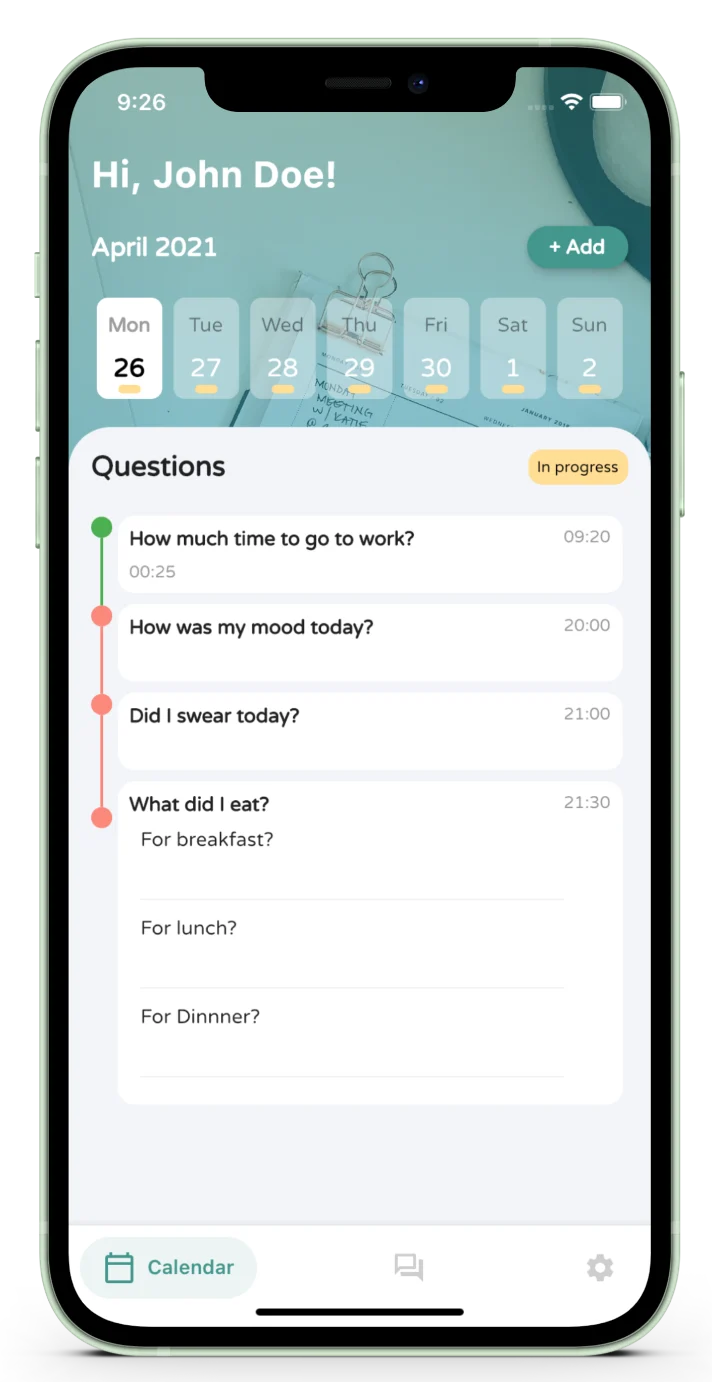
The best journal is the one available when you are ready to be honest. A paper journal offers focus, physicality, and freedom. A digital journal offers portability, reminders, search, and easier pattern review.
Neither format is inherently more authentic. Choose based on the friction you experience, not the identity you want to perform.
Digital vs paper at a glance
| Consideration | Digital journal | Paper journal |
|---|---|---|
| Availability | Usually already in your pocket | Requires carrying a notebook |
| Focus | Can compete with notifications | Naturally single-purpose |
| Search | Fast keyword and date search | Manual rereading |
| Prompts | Scheduled and repeatable | Written or selected manually |
| Long-term patterns | Easier to compare and visualize | Rich but slower to review |
| Expression | Text, ratings, structured answers | Drawing, layout, unrestricted pages |
| Privacy | Depends on app and account design | Depends on physical storage |
Choose digital if consistency is the problem
A journal app can remove several small barriers. It can remind you at a chosen moment, offer the same question each day, and keep entries automatically organized. That makes digital journaling especially useful for mood tracking, sleep reflection, and repeated questions.
The risk is distraction. Turn off unrelated notifications, keep entries short, and avoid an app that makes you manage a complicated system before you can write.
Choose paper if attention is the problem
Paper creates a boundary. There are no tabs, metrics, or incoming messages. Writing by hand can slow thought enough to make room for details that typing might outrun.
The risk is logistical friction. A notebook left at home cannot support a lunchtime check-in. Paper is also harder to search when you want to compare six months of answers.
Use a hybrid without duplicating everything
You do not have to choose one format forever. Give each medium a distinct job:
- Use a digital prompt for a ten-second daily check-in.
- Use paper for longer weekly reflection.
- Transfer only the insight, not every entry.
This avoids maintaining two identical archives while preserving the strengths of both.
Five questions to decide
- Where am I most likely to reflect?
- Do reminders help me or interrupt me?
- Do I want free writing or comparable answers?
- Will I review old entries by date, theme, or feeling?
- What privacy model makes me comfortable?
Try one format for two weeks, then review the behavior rather than the fantasy. Did you use it? Did it help you notice something? Did the tool disappear once reflection began?
If you choose digital, EvereeME offers a deliberately narrow experience: personal questions, brief answers, reminders you control, and a timeline built for looking back.